

Research
Understanding the Belief–Behavior Systems Archetype
The Belief–Behavior Systems Archetype is an interdisciplinary proposed explanatory framework investigating a fundamental scientific question:
What underlying cognitive and epistemological mechanism gives rise to supervisory belief–behavior systems across human hierarchies, and how does that mechanism influence humanity's capacity to learn, solve problems, and adapt?
This page traces the development of that investigation from its original observations of supervisory behavior through the theoretical foundations of the framework and the broader implications of the proposed explanatory mechanism. It examines how unconscious epistemological beliefs concerning the certainty of one's own knowledge are proposed to influence supervisory cognition and explores how this mechanism may shape continued learning, the development of increasingly accurate explanatory rules, improved problem solving, the pursuit of truth and justice, democratic human hierarchies, and the long-term adaptability and sustainability of human institutions.
Rather than presenting isolated concepts, the Research page introduces an integrated explanatory framework connecting supervisory cognition with humanity's adaptive capacity across diverse institutional contexts.
Development of the Belief-Behavior Systems Archetype
The Scientific Question
Understanding how human hierarchies learn, adapt, and respond to new knowledge has long been a central concern of research in leadership, organizational learning, education, psychology, and the social sciences. Previous theories have described a wide range of supervisory behaviors, leadership styles, organizational cultures, and cognitive biases that influence individual and institutional performance. Collectively, these contributions have advanced understanding of what supervisors do and how supervisory behaviors affect those they lead. However, they do not fully explain the underlying cognitive mechanism that gives rise to characteristic patterns of supervisory thought, feeling, and behavior across diverse human hierarchies.
The research underlying the Belief–Behavior Systems Archetype originated with a different question:
What underlying cognitive and epistemological mechanism gives rise to supervisory belief–behavior systems across human hierarchies?
Rather than viewing supervisory behavior as the primary object of investigation, the research examined the cognitive processes that precede observable behavior. This shift in perspective led from the study of organizational learning and supervisory practices to the investigation of human cognition, unconscious bias, and ultimately the epistemological beliefs that individuals hold concerning the certainty of their own knowledge. The resulting framework proposes that these unconscious epistemological beliefs constitute an underlying mechanism influencing supervisory cognition and the supervisory belief–behavior systems that emerge across human hierarchies.
The framework further proposes that supervisory cognition is shaped by the interaction of two independent components: underlying intention and unconscious epistemological belief. Underlying intention reflects whether a supervisor seeks to advance the common good or to advance personal power at the expense of the common good. Unconscious epistemological belief reflects the degree of certainty a supervisor unconsciously attributes to the correctness and completeness of his or her own knowledge. Together, these components are proposed to influence the characteristic patterns of conscious feelings, thoughts, and behaviors that constitute supervisory belief–behavior systems.
By shifting the focus from observable supervisory behavior to the cognitive and epistemological mechanisms that precede it, the Belief–Behavior Systems Archetype provides a unified explanatory framework for understanding why supervisory belief–behavior systems emerge across diverse human hierarchies and how they may influence learning, institutional adaptability, health, well-being, justice, and the advancement of the common good.
The Belief–Behavior Systems Archetype
The Belief–Behavior Systems Archetype proposes that supervisory belief–behavior systems arise from the interaction of two independent components of supervisory cognition: underlying intention and unconscious epistemological belief. Together, these components are proposed to constitute an underlying cognitive and epistemological mechanism that gives rise to characteristic patterns of supervisory thought, feeling, and behavior across human hierarchies.
Underlying intention concerns the supervisor's fundamental purpose. Supervisors may seek to advance the common good by promoting learning, transparency, and collaborative inquiry, or they may seek to advance personal power at the expense of the common good through manipulation or exploitation. While intention determines the supervisor's fundamental objective, the framework proposes that intention alone does not determine how supervisory authority is exercised.
The second component, unconscious epistemological belief, concerns the certainty that supervisors unconsciously attribute to the correctness and completeness of their own knowledge. According to the framework, supervisors who unconsciously believe, "I know that I am right," are less likely to recognize previously unrecognized limitations in their own knowledge. This epistemological certainty is proposed to give rise to autocratic supervisory belief–behavior systems characterized by coercion, conformity, censorship, and preservation of existing assumptions. Conversely, supervisors who unconsciously believe, "I think I am right, but I do not know that I am right," remain open to the possibility that their understanding may be incomplete. This epistemological humility is proposed to facilitate democratic supervisory belief–behavior systems characterized by transparency, collaborative inquiry, questioning of assumptions, and shared learning.
The framework further proposes that supervisory belief–behavior systems are not isolated behaviors but characteristic patterns of conscious feelings, thoughts, and behaviors that emerge from the interaction of underlying intention and unconscious epistemological belief. These patterns influence how supervisors exercise authority, respond to disagreement, evaluate new information, and engage with the knowledge of others. Because these cognitive processes precede observable behavior, the framework shifts attention from describing supervisory styles to explaining the underlying mechanism that gives rise to them.
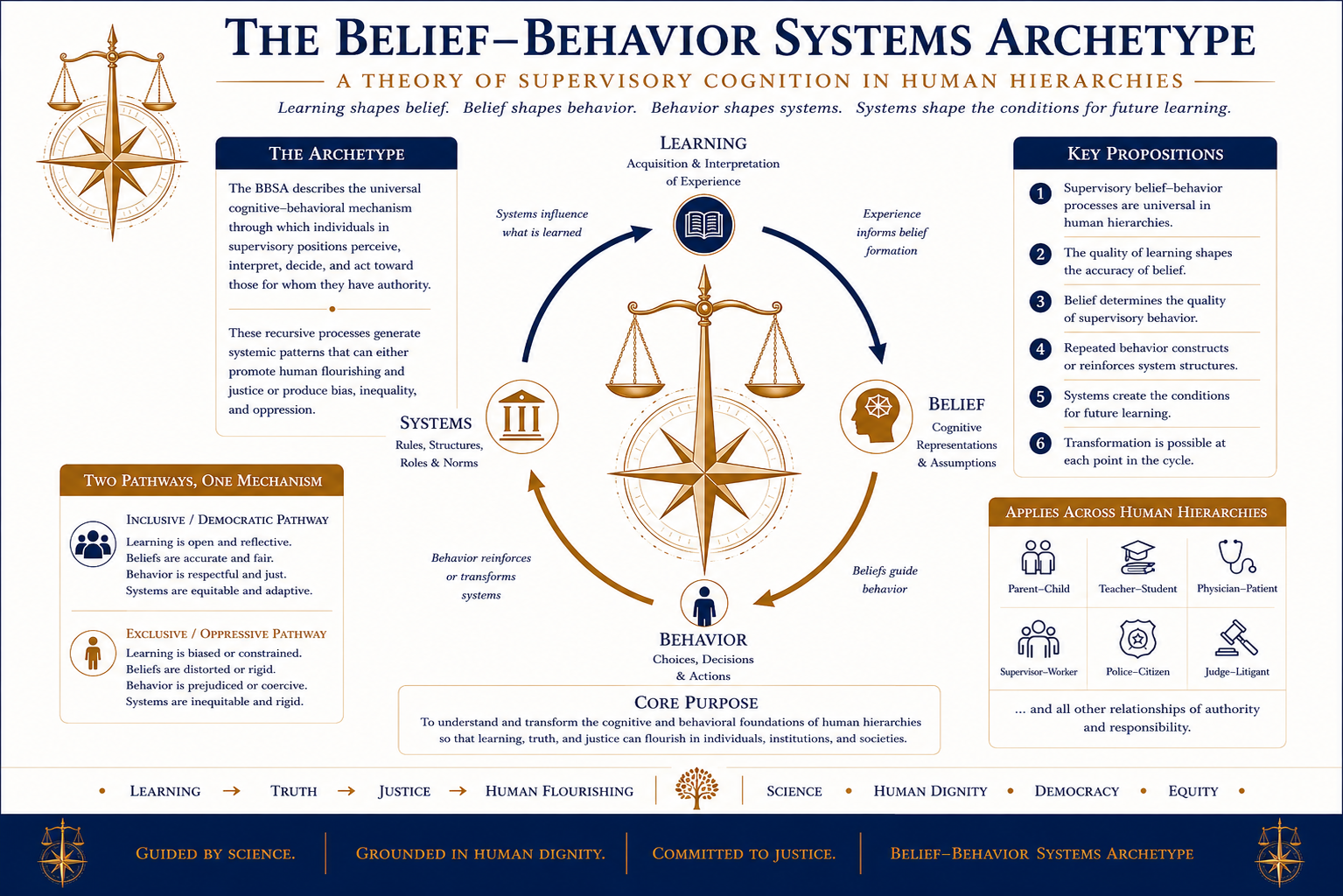
Figure 1. The Belief–Behavior Systems Archetype. The framework proposes that supervisory belief–behavior systems arise from the interaction of underlying intention and unconscious epistemological belief. These interacting components influence characteristic patterns of supervisory cognition and behavior that shape learning, institutional adaptability, health, well-being, justice, and the advancement of the common good across diverse human hierarchies.
By identifying unconscious epistemological beliefs as an underlying mechanism of supervisory cognition, the Belief–Behavior Systems Archetype provides a unified explanatory framework for understanding how supervisory belief–behavior systems influence learning, institutional adaptability, organizational performance, health, well-being, justice, and the advancement of the common good across diverse human hierarchies.
Core Principles
The Belief–Behavior Systems Archetype is founded on five interrelated principles that explain how supervisory cognition gives rise to characteristic supervisory belief–behavior systems across human hierarchies. Together, these principles provide a framework for understanding why supervisors with similar intentions may exhibit markedly different patterns of thought, behavior, and decision-making, and why these differences influence learning, institutional adaptability, and the well-being of those they supervise.
Supervisory cognition consists of two independent components
The framework proposes that supervisory cognition is determined by the interaction of two independent components: underlying intention and unconscious epistemological belief. Underlying intention concerns whether a supervisor seeks to advance the common good or to advance personal power at the expense of the common good. Unconscious epistemological belief concerns the certainty the supervisor unconsciously attributes to the correctness and completeness of his or her own knowledge. Because these components are independent, supervisors with similar intentions may nevertheless develop fundamentally different supervisory belief–behavior systems.
Supervisory belief–behavior systems originate in cognition rather than behavior
The framework proposes that supervisory belief–behavior systems are not simply collections of leadership behaviors or management techniques. Rather, they are characteristic patterns of conscious feelings, thoughts, and behaviors that emerge from underlying cognitive and epistemological processes. Observable supervisory behavior is therefore understood as the expression of deeper mechanisms operating within supervisory cognition rather than the mechanism itself.
Unconscious epistemological beliefs influence the capacity to recognize previously unrecognized limitations in one's own knowledge
A central proposition of the framework is that supervisors continually interpret new information through unconscious beliefs concerning the certainty of their own knowledge. Supervisors who unconsciously believe, "I know that I am right," are proposed to become less capable of recognizing previously unrecognized limitations in their own understanding. By contrast, supervisors who unconsciously believe, "I think I am right, but I do not know that I am right," remain cognitively open to questioning assumptions, recognizing uncertainty, and learning from others. The framework therefore identifies unconscious epistemological belief as an underlying mechanism influencing whether supervisory cognition supports or constrains learning.
Democratic and autocratic supervisory belief–behavior systems emerge from different epistemological beliefs
The framework distinguishes democratic and autocratic supervisory belief–behavior systems not primarily by the supervisor's intention, but by the unconscious epistemological beliefs through which that intention is expressed. Supervisors whose intentions are directed toward advancing the common good may nevertheless develop either democratic or autocratic supervisory belief–behavior systems depending upon whether they unconsciously approach their own knowledge with epistemological humility or epistemological certainty. Democratic supervisory belief–behavior systems facilitate transparency, collaborative inquiry, questioning of assumptions, and shared learning. Autocratic supervisory belief–behavior systems are proposed to replace these processes with coercion, conformity, censorship, and preservation of existing assumptions, thereby constraining institutional learning despite intentions directed toward advancing the common good.
The framework provides a unified explanatory mechanism across human hierarchies
Rather than proposing separate theories for leadership, education, healthcare, law, business, or government, the Belief–Behavior Systems Archetype proposes that the same underlying cognitive and epistemological mechanism operates across supervisory relationships characterized by authority over and responsibility to another. By identifying this common mechanism, the framework provides a unified explanatory framework for understanding supervisory cognition across diverse human hierarchies and establishes a foundation for interdisciplinary research into learning, institutional adaptability, health, well-being, justice, democratic governance, and the advancement of the common good.
Human Hierarchies
The Belief–Behavior Systems Archetype proposes that the underlying cognitive and epistemological mechanisms influencing supervisory belief–behavior systems are not unique to any single profession, institution, or organizational setting. Rather, the framework proposes that these mechanisms operate across human hierarchies—relationships in which one individual possesses authority over and responsibility to another. Although the purposes, structures, and responsibilities of these hierarchies differ, they share a common supervisory dynamic in which decisions, communication, learning, and accountability are influenced by supervisory cognition.
Within the framework, a human hierarchy is defined as any relationship or institutional structure in which an individual or group exercises authority while simultaneously bearing responsibility for the welfare, development, rights, or performance of others. This conception extends beyond formal organizational leadership to encompass supervisory relationships throughout society, including parent–child, teacher–student, physician–patient, supervisor–subordinate, manager–employee, law enforcement–citizen, judge–litigant, military commander–service member, coach–athlete, and mentor–learner relationships. In each of these contexts, supervisors make decisions, interpret information, respond to uncertainty, and influence the learning and behavior of those under their authority.
The framework proposes that the same underlying cognitive and epistemological mechanism influences supervisory cognition across these diverse contexts. Regardless of the institutional setting, supervisors continually evaluate information through unconscious beliefs concerning the certainty of their own knowledge. These epistemological beliefs are proposed to influence how supervisors interpret evidence, respond to disagreement, recognize previously unrecognized limitations in their own understanding, and exercise authority. Consequently, supervisory belief–behavior systems are understood not as profession-specific phenomena, but as expressions of common cognitive processes operating across human hierarchies.
This interdisciplinary perspective distinguishes the Belief–Behavior Systems Archetype from theories developed primarily within individual disciplines or professions. Rather than proposing separate explanations for leadership in business, education, healthcare, government, or the justice system, the framework offers a unified explanatory mechanism for understanding supervisory cognition across these domains. It suggests that differences in institutional purpose do not alter the underlying cognitive processes through which supervisory belief–behavior systems emerge, even though the consequences of those systems may vary according to the responsibilities and objectives of each hierarchy.
Because supervisory relationships influence how individuals learn, collaborate, solve problems, resolve conflict, and exercise authority, the framework proposes that supervisory cognition has implications extending beyond organizational performance alone. Across human hierarchies, supervisory belief–behavior systems may influence educational outcomes, patient care, workplace innovation, public trust, judicial fairness, democratic governance, health, well-being, and the advancement of the common good. By identifying a common cognitive and epistemological mechanism operating across these diverse relationships, the Belief–Behavior Systems Archetype provides a scientific foundation for interdisciplinary research into the factors that influence both individual and institutional outcomes.

Figure 3. The Belief–Behavior Systems Archetype proposes that the same underlying cognitive and epistemological mechanism influences supervisory belief–behavior systems across human hierarchies characterized by authority over and responsibility to another. Although these hierarchies differ in purpose and institutional context, they share common supervisory processes through which cognition influences learning, decision-making, and institutional outcomes
Applications
Because the Belief–Behavior Systems Archetype proposes a common cognitive and epistemological mechanism underlying supervisory belief–behavior systems, it provides an interdisciplinary framework for examining supervisory relationships across a wide range of human institutions. Rather than offering profession-specific models of leadership or management, the framework seeks to explain how supervisory cognition may influence learning, decision-making, collaboration, and institutional outcomes regardless of the organizational setting.
In education, the framework provides a conceptual basis for examining how supervisory cognition influences teaching, learning, and intellectual development. Democratic supervisory belief–behavior systems are proposed to facilitate transparency, questioning of assumptions, collaborative inquiry, and the recognition of previously unrecognized limitations in one's own knowledge, thereby supporting learning among both educators and students. Conversely, supervisory cognition characterized by epistemological certainty may encourage conformity, discourage questioning, and preserve existing assumptions, potentially constraining learning despite intentions directed toward advancing students' educational development.
In healthcare, the framework may be applied to supervisory relationships among physicians, nurses, trainees, administrators, and patients. By emphasizing the role of supervisory cognition in recognizing uncertainty, responding to new evidence, and facilitating collaborative problem-solving, the framework provides a conceptual foundation for examining clinical supervision, organizational learning, patient safety, physician well-being, and the continuous improvement of healthcare systems.
In business and organizational leadership, the framework provides an explanatory perspective on how supervisory cognition may influence innovation, organizational learning, employee engagement, adaptability, and institutional performance. Rather than attributing organizational outcomes solely to management practices or leadership styles, the framework proposes that supervisory belief–behavior systems arise from deeper cognitive and epistemological processes that shape how leaders interpret information, evaluate alternative perspectives, and respond to changing circumstances.
In government, public administration, and the justice system, the framework offers a basis for examining supervisory relationships in which authority is exercised on behalf of the public. Applications include public administration, regulatory agencies, law enforcement, and judicial systems, where supervisory cognition may influence transparency, accountability, procedural fairness, public trust, and the capacity of institutions to recognize and respond to previously unrecognized limitations in policy, decision-making, and institutional practice.
The framework also has potential applications in emerging interdisciplinary fields, including artificial intelligence, where understanding supervisory cognition may inform the design of human-centered systems that support transparency, collaborative reasoning, and responsible decision-making. As AI increasingly assists human judgment rather than replacing it, the framework provides a conceptual foundation for investigating how human epistemological beliefs influence the interpretation, acceptance, and oversight of machine-generated information.
Across these diverse applications, the Belief–Behavior Systems Archetype does not propose separate theories for individual professions or institutions. Instead, it advances a unified explanatory framework in which unconscious epistemological beliefs concerning the certainty of one's own knowledge are proposed to influence supervisory cognition across human hierarchies. By identifying this common mechanism, the framework establishes a scientific foundation for interdisciplinary research into learning, institutional adaptability, health, well-being, justice, democratic governance, and the advancement of the common good.
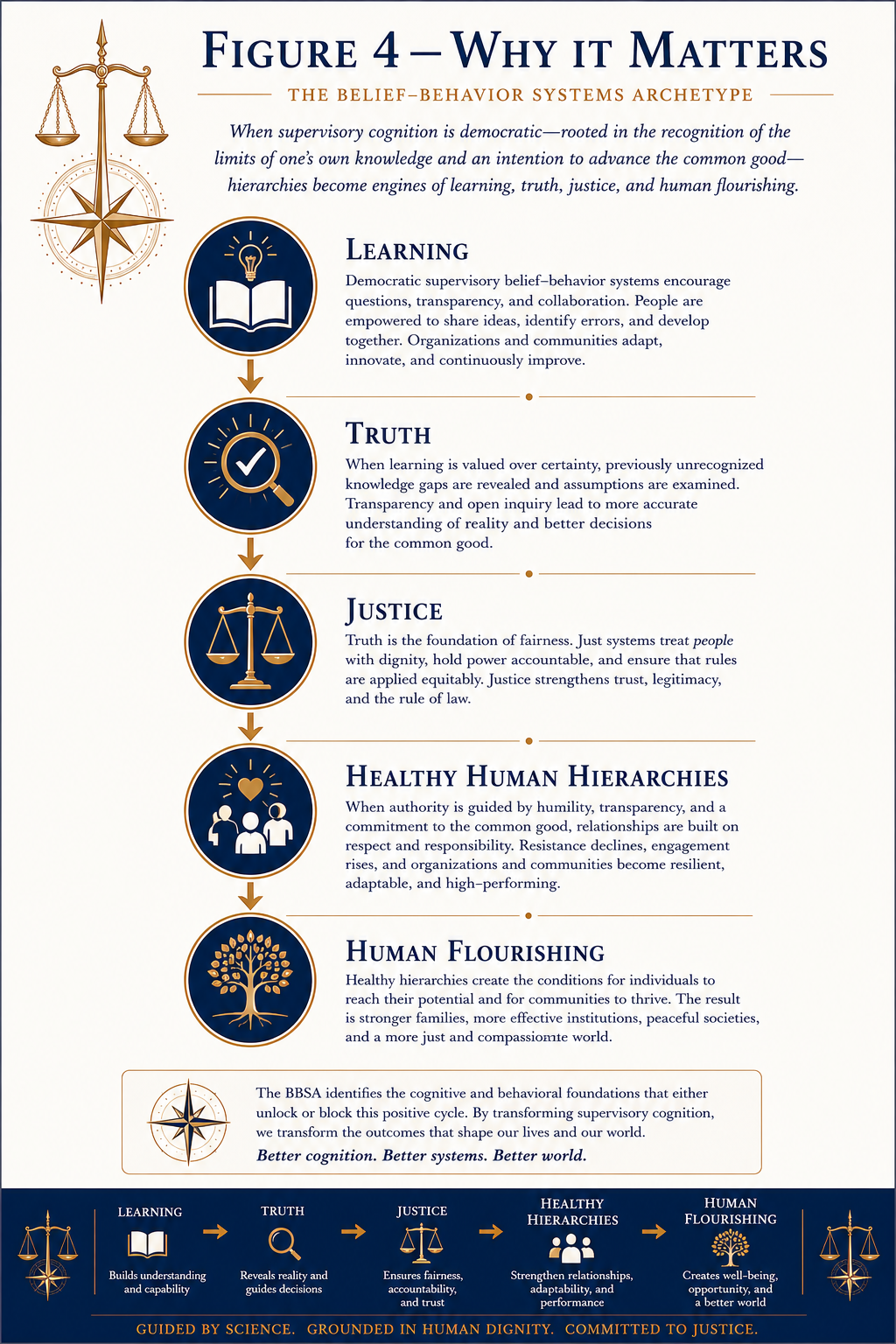
Development of the Framework
The Belief–Behavior Systems Archetype emerged through a progressive program of interdisciplinary research investigating the relationships among supervisory behavior, organizational learning, human cognition, unconscious bias, and epistemological beliefs. Rather than beginning with a predetermined theoretical model, the framework developed through successive inquiry into increasingly fundamental questions concerning the mechanisms that influence supervisory cognition across human hierarchies.
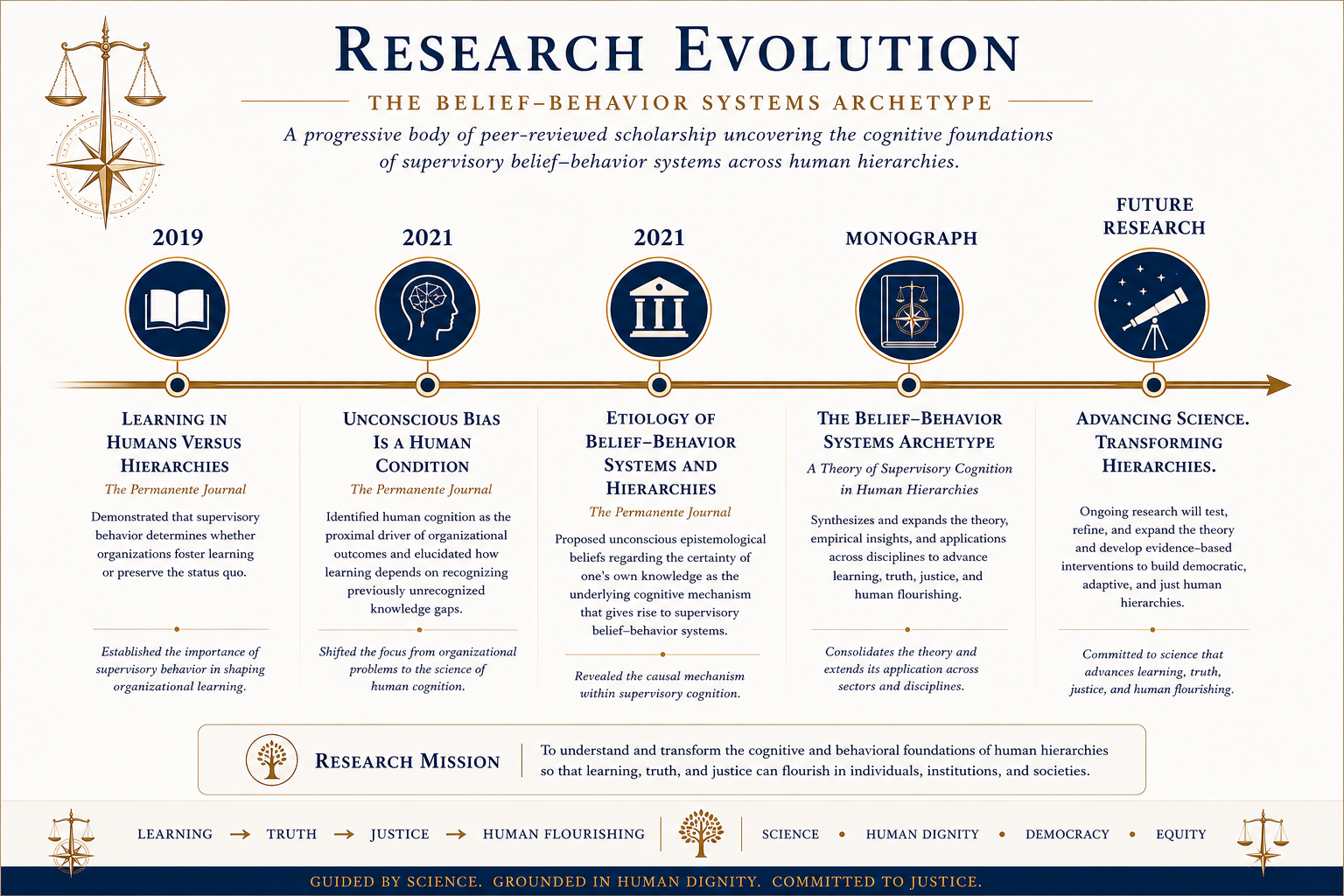
The first publication, Learning in Humans versus Hierarchies (2019), examined how supervisory behavior influences organizational learning and institutional adaptability. The article proposed that learning depends not only on the acquisition of new knowledge but also on supervisory environments that encourage individuals to answer questions, identify errors, contribute new ideas, and participate in collaborative problem-solving. The research suggested that supervisory practices play a central role in determining whether organizations remain adaptable through continuous learning or preserve existing assumptions despite changing circumstances.
Building upon these findings, Unconscious Bias Is a Human Condition (2021) shifted the research from organizational processes to the cognitive mechanisms underlying human learning. The publication proposed that unconscious bias is an inherent characteristic of human cognition and argued that continued learning requires recognizing previously unrecognized limitations in one's own understanding. This investigation extended the research beyond observable supervisory behavior toward the cognitive and epistemological processes through which individuals evaluate knowledge, respond to uncertainty, and ultimately shape supervisory decision-making.
The third publication, Etiology of Belief–Behavior Systems and Hierarchies (2021), extended this line of inquiry by proposing that unconscious epistemological beliefs concerning the certainty of one's own knowledge constitute an underlying mechanism influencing supervisory cognition. The article distinguished between underlying intention and unconscious epistemological belief as independent components of supervisory cognition and proposed that their interaction gives rise to characteristic supervisory belief–behavior systems across human hierarchies. This work provided the theoretical foundation for understanding how democratic and autocratic supervisory belief–behavior systems may emerge even among supervisors who share similar intentions.
Together, these publications culminated in the broader Belief–Behavior Systems Archetype, an interdisciplinary conceptual framework that integrates organizational learning, human cognition, unconscious bias, and epistemological beliefs into a unified explanatory model of supervisory cognition. By progressively moving from the study of organizational outcomes to the investigation of increasingly fundamental cognitive and epistemological mechanisms, the research established a scientific foundation for examining supervisory belief–behavior systems across education, healthcare, business, government, law, and other human hierarchies.
Since its publication, the research underlying the framework has been cited and applied by independent scholars across multiple academic disciplines, including medicine, health professions education, education, engineering, law, maritime studies, and artificial intelligence. These interdisciplinary applications have primarily incorporated the publications into discussions of supervisory judgment, organizational learning, unconscious bias, reflective practice, and professional education, demonstrating the framework's relevance beyond the contexts in which it was originally developed.
Future Directions
The Belief–Behavior Systems Archetype is intended not as the conclusion of a line of inquiry, but as a foundation for continued interdisciplinary research into supervisory cognition across human hierarchies. By proposing that unconscious epistemological beliefs concerning the certainty of one's own knowledge constitute an underlying mechanism influencing supervisory belief–behavior systems, the framework establishes a conceptual basis for generating new hypotheses, guiding empirical investigation, and integrating scholarship across disciplines that have traditionally examined supervisory relationships independently.
Future research may examine the framework's theoretical propositions through qualitative, quantitative, and mixed-methods approaches. Potential areas of investigation include the development and validation of measures of supervisory cognition, the relationship between unconscious epistemological beliefs and supervisory decision-making, and the influence of supervisory belief–behavior systems on learning, institutional adaptability, organizational performance, health, well-being, justice, and democratic governance. Such studies may also explore how supervisory cognition evolves over time and under what conditions democratic supervisory belief–behavior systems can be cultivated and sustained.
The interdisciplinary nature of the framework creates opportunities for collaboration among researchers in education, healthcare, organizational science, psychology, law, public administration, engineering, artificial intelligence, and other fields concerned with supervisory relationships. Because the proposed mechanism is not specific to any single profession or institution, investigations conducted within one domain may inform understanding across many others, contributing to the development of a more unified science of supervisory cognition.
The framework also provides a foundation for translating theory into practice. Future scholarship may investigate how understanding supervisory cognition can inform professional education, leadership development, institutional governance, organizational improvement, and the design of systems that promote transparency, collaborative inquiry, and continuous learning. As artificial intelligence becomes increasingly integrated into human decision-making, the framework may also contribute to research exploring how human epistemological beliefs shape the interpretation, oversight, and responsible use of AI-assisted reasoning.
Ultimately, the Belief–Behavior Systems Archetype seeks to advance an interdisciplinary research program centered on a fundamental scientific question: How do the cognitive and epistemological processes of supervisors influence the individuals, institutions, and societies they serve? By providing a unified explanatory framework for investigating this question across human hierarchies, the framework establishes a foundation for continued theoretical development, empirical research, and practical application aimed at strengthening learning, institutional adaptability, health, well-being, justice, democratic governance, and the advancement of the common good.
The Research page provides an overview of the Belief–Behavior Systems Archetype. Readers interested in the complete theoretical development of the framework are invited to explore the Monograph, while the original peer-reviewed publications and evidence of the framework's scholarly influence are available through the Publicationsand Impactpages. Additional information about the research program and its development is available on the Aboutpage. Together, these resources document the continuing evolution of an interdisciplinary research program investigating supervisory cognition across human hierarchies.