

Research Program Portfolio
A Continuing Scientific Investigation
The Belief–Behavior Systems Archetype (BBSA) is an interdisciplinary research program investigating how supervisory cognition influences humanity's capacity for continued learning within human hierarchies.
The research developed through a progressive sequence of investigations into a fundamental problem of hierarchical learning: the resources necessary for learning become structurally distributed across supervisory relationships. This distribution expands humanity's capacity for specialization, coordinated effort, innovation, and collective problem solving, but it may also insulate supervisors from the frontline intellectual currency necessary to recognize and correct limitations in their own understanding.
The research therefore progressed from investigating the structural distribution of learning resources, to the hierarchical insulation of unconscious cognitive error, to supervisory and subordinate adaptation and organizational knowledge flow, and ultimately to the cognitive and epistemological mechanisms proposed to underlie recurring supervisory belief–behavior systems.
From this progression, the Belief–Behavior Systems Archetype developed as a proposed explanatory, diagnostic, and developmental framework for investigating supervisory cognition within human hierarchies.
At the center of the framework is a proposed integrative mechanism: supervisory cognition influences whether distributed intellectual and organizational resources become effectively connected for continued learning or remain separated.
The research therefore returns to the structural problem from which it began:
How do human hierarchies continue learning when the resources necessary for learning become distributed across supervisory relationships?
The sections that follow introduce the scientific problem, central proposition, scientific philosophy, peer-reviewed foundations, visual syntheses, interdisciplinary applications, and continuing directions of the research program.
The Scientific Problem
Human hierarchies expand humanity's capacity for collective learning by distributing expertise, responsibility, authority, and other resources across supervisory relationships. Unlike individual learners, however, no single participant necessarily possesses all of the resources required to recognize a problem, develop a better explanation, and act upon that understanding.
Those closest to the work may possess frontline intellectual currency—observations, experience, expertise, questions, disagreement, alternative explanations, and corrective information capable of revealing emerging problems or previously unrecognized limitations in current understanding. Supervisors, meanwhile, may control complementary organizational resources such as authority, time, funding, priority, accountability, and action.
Continued organizational learning therefore requires these distributed resources to be brought back together.
This structural distribution creates both the extraordinary adaptive capacity of human hierarchies and their fundamental vulnerability. A hierarchy may possess the knowledge necessary to recognize or solve a problem while that knowledge remains disconnected from the organizational resources necessary to investigate or act upon it. Supervisors may consequently become insulated from the very intellectual currency capable of revealing and correcting limitations in their own understanding.
This raised the foundational scientific question:
How do human hierarchies continue learning when the resources necessary for learning become structurally distributed across supervisory relationships?
The research pursued this problem through a progressive sequence of questions:
How does learning within human hierarchies differ from individual human learning?
Why can the structural distribution of learning resources insulate supervisory cognitive error from correction?
How do supervisory and subordinate belief–behavior systems influence organizational knowledge flow?
What underlying cognitive and epistemological mechanism gives rise to recurring supervisory belief–behavior systems?
How does that mechanism influence whether distributed learning resources become effectively reintegrated for continued organizational learning?
Together, these investigations culminated in the Belief–Behavior Systems Archetype, a proposed explanatory, diagnostic, and developmental framework for investigating supervisory cognition within human hierarchies.
The framework effectively returns to the problem from which the research began. It proposes that supervisory cognition functions as the integrative mechanism through which distributed intellectual and organizational resources either become effectively connected or remain separated.
The scientific problem can therefore be expressed simply:
Human hierarchies gain their extraordinary capacity for collective learning by distributing the resources necessary for learning. Their continued adaptability depends upon whether supervisory cognition enables those resources to be brought back together.
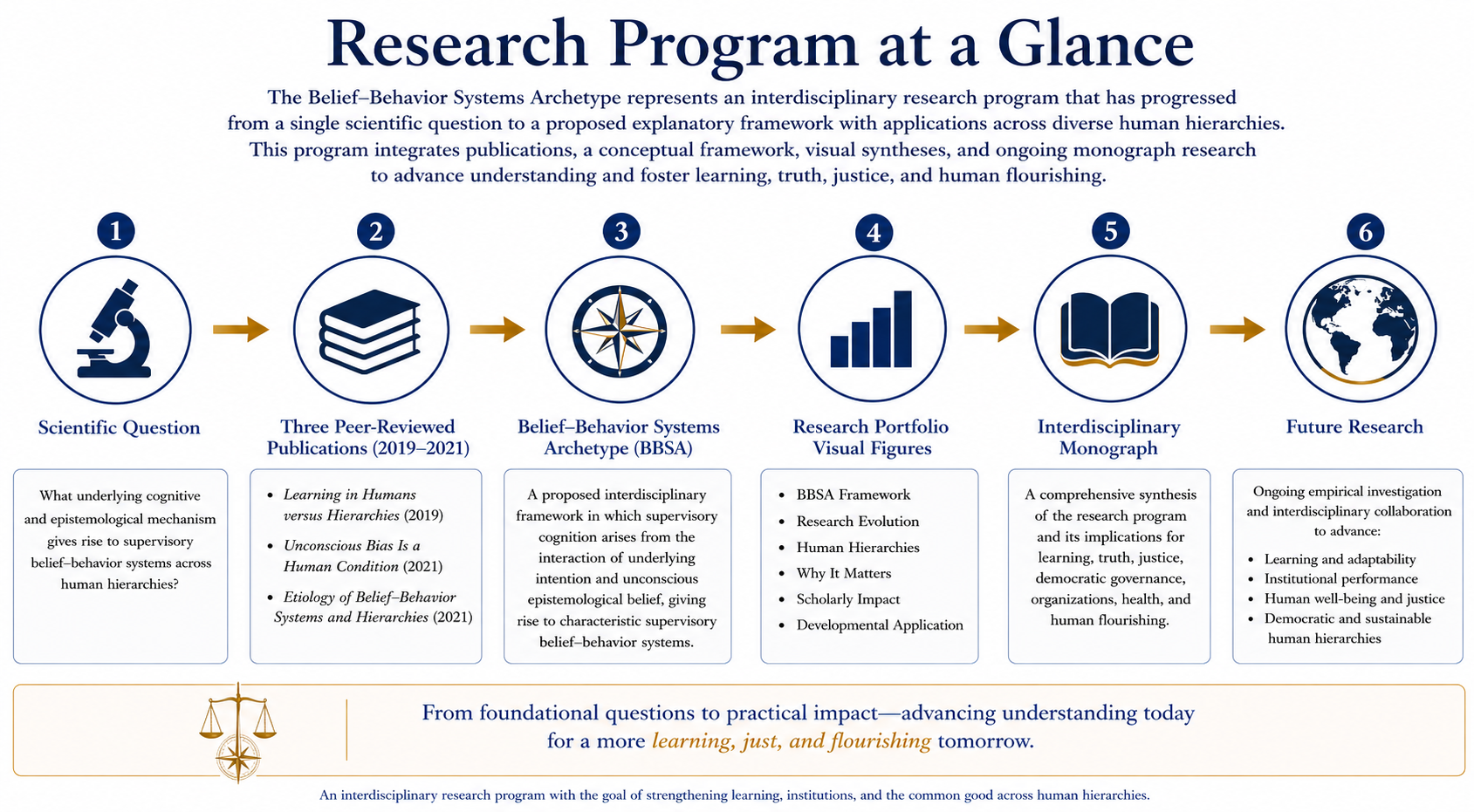
Figure 1 summarizes the progression of the research program from its initial scientific question through peer-reviewed publications, the Belief–Behavior Systems Archetype, the research portfolio, the interdisciplinary monograph, and future empirical investigation.
The Central Scientific Proposition
The Belief–Behavior Systems Archetype proposes that human hierarchies achieve their extraordinary capacity for collective learning by structurally distributing intellectual and organizational resources across supervisory relationships. That same distribution, however, creates their fundamental structural and cognitive vulnerability: supervisors may become insulated from the frontline intellectual currency necessary to recognize and correct limitations in their own understanding.
The framework proposes that supervisory cognition functions as the integrative mechanism through which the distributed intellectual and organizational resources necessary for continued learning either become effectively connected or remain structurally separated within human hierarchies.
Consequently, supervisory cognition influences whether observations, expertise, disagreement, questions, alternative explanations, and corrective information become available for organizational learning—or whether organizational resources remain disconnected from the knowledge necessary to solve emerging problems and adapt to changing conditions.
Scientific Philosophy
Learning
Human learning advances by recognizing recurring patterns and discovering increasingly accurate explanatory rules.
Supervisory Cognition
Supervisory cognition influences whether distributed learning resources are recognized, valued, and effectively integrated for continued learning within human hierarchies.
Human Hierarchies
Human hierarchies expand humanity's capacity for collective learning by distributing intellectual and organizational resources across supervisory relationships.
Truth
Truth is approached through continual questioning, testing, refinement, and increasing correspondence between explanatory models and reality.
Meaningful Participation
Human hierarchies depend not only upon the distribution of intellectual currency, but upon whether the people who possess that intellectual currency can meaningfully contribute it to collective learning and problem solving.
Human Sustainability
Sustainable human hierarchies depend upon both the capacity to continue learning and adapting and the capacity to sustain the people whose knowledge, participation, and effort make that learning and adaptation possible.
Intellectual Humility
Continued learning depends upon recognizing the possibility that one's current understanding may be incomplete and remaining receptive to previously unrecognized corrective information.
Within the framework, intellectual humility concerns openness to limitations in one's knowledge; it is conceptually independent from the intention toward which supervisory authority is directed.
Foundational Publications

Learning in Humans versus Hierarchies (2019)
Human hierarchies structurally distribute the resources necessary for learning.

Unconsciou Bias is a Human Condition (2021)
That distribution creates a fundamental structural and cognitive vulnerability.

Etiology of Belief-Behavior Systems and Hierarchies (2021)
Supervisory cognition and subordinate adaptation influence organizational knowledge flow, while underlying intention and unconscious epistemological belief provide the proposed cognitive and epistemological architecture underlying recurring supervisory belief–behavior systems.

The Belief-Behavior Systems Archetype Monograph (2026)
Underlying cognitive and epistemological mechanism.
Research Figures and Visual Syntheses
The research portfolio includes a comprehensive collection of original publication figures and Research Portfolio Edition figures that collectively document the evolution, scientific foundations, conceptual framework, interdisciplinary applications, and continuing development of the Belief–Behavior Systems Archetype. Together, these figures provide a visual synthesis of the research program, illustrating both the progression of the underlying scientific investigations and the proposed explanatory, diagnostic, and developmental framework that emerged from them.
The collection comprises:
Three original peer-reviewed publication figures presented in their published form.
Research Portfolio Edition figures illustrating the scientific evolution of the research program from its initial investigations through the development of the Belief–Behavior Systems Archetype.
Framework figures that explain the framework's underlying mechanisms, core principles, interdisciplinary applications, and developmental implications across human hierarchies.
Collectively, these figures synthesize the progression of the research program and illustrate the relationships among its principal concepts, explanatory mechanisms, and applications..
Peer Reviewed Publications
Learning in Humans versus Hierarchies (2019)
Established that human hierarchies structurally distribute the resources necessary for learning, making supervisory integration essential for organizational learning.
Unconscious Bias Is a Human Condition (2021)
Proposed that unconscious bias helps explain why supervisors sometimes fail to recognize and integrate the frontline intellectual currency necessary for continued organizational learning.
Etiology of Belief–Behavior Systems and Hierarchies (2021)
Proposed the underlying cognitive and epistemological mechanism giving rise to recurring supervisory belief–behavior systems that determine whether distributed learning resources are integrated.
Monograph
The Belief–Behavior Systems Archetype: Learning, Truth, Justice, and the Science of Human Hierarchies (2026)
A comprehensive interdisciplinary monograph synthesizing the research program and examining its implications for education, healthcare, organizations, government, law, democratic governance, and other human hierarchies.
Version of Record
First Edition (2026)
DOI: 10.5281/zenodo.21960008
Print ISBN: 9798259889873
Scholarly Reception and Applications
The publications underlying the Belief–Behavior Systems Archetype have been cited and discussed by independent scholars across multiple academic disciplines, including:
Medicine
Health professions education
Education
Engineering
Business ethics
Law
Maritime studies
Artificial intelligence
Forensic psychology
The publications have been incorporated into literature reviews, comparative analyses, educational research, engineering education, legal scholarship, professional practice, doctoral research, and bibliometric analyses of the unconscious bias literature. Independent authors have engaged with concepts including organizational learning, supervisory cognition, unconscious bias, reflective practice, professional education, supervisory judgment, organizational knowledge flow, and institutional decision-making.
Collectively, this interdisciplinary scholarship demonstrates growing engagement with the foundational publications while providing opportunities for continued empirical investigation of the Belief–Behavior Systems Archetype.
Professional and Scholarly Recognition
2019 – UCSF Excellence in Student Teaching Award
Selected by medical students in recognition of learner-centered teaching, educational mentorship, and contributions to clinical education. Student nominations emphasized an educational philosophy centered on developing independent learning and clinical reasoning.
2021 – BioInnovation Institute & Science Prize for Innovation
As part of an application to the 2021 BioInnovation Institute and Science Prize for Innovation, supporting letters described the Belief–Behavior Systems Archetype as a potentially broad interdisciplinary framework with applications extending beyond medicine into education, business, public policy, and democratic institutions.
2021 – California Academy of Family Physicians
The California Academy of Family Physicians formally supported Dr. Emberton's nomination for the American Academy of Family Physicians Public Health Award, describing the Belief–Behavior Systems Archetype as a multidisciplinary framework with implications for medical education, physician burnout, health policy, and health equity.
Future Research
Future investigations will examine:
Development and measurement of supervisory cognition.
Empirical investigation of unconscious epistemological beliefs.
Democratic supervisory belief–behavior systems.
Knowledge flow and distributed learning resources.
Organizational learning and institutional adaptability.
Applications across education, healthcare, law, government, public administration, and artificial intelligence.
The long-term objective of this research program is to encourage interdisciplinary collaboration examining how supervisory cognition influences humanity's capacity to learn, solve problems, pursue truth and justice, and sustain healthy human hierarchies.
Continuing the Investigation
The Belief–Behavior Systems Archetype remains an evolving interdisciplinary research program.
Current investigations seek to examine how supervisory cognition can be measured, empirically tested, and intentionally developed; how supervisory belief–behavior systems influence knowledge flow across diverse human hierarchies; and whether strengthening intellectual humility and improving the integration of distributed learning resources can enhance continued learning, institutional adaptability, democratic governance, and long-term human flourishing.
The research therefore continues to investigate a single foundational proposition:
Human hierarchies do not fail because they lack knowledge. They fail when the knowledge necessary to recognize and correct supervisory cognitive error is not effectively integrated with the organizational resources necessary to act upon it.