

The Evolution of the Belief–Behavior Systems Archetype Research Program
Scientific research rarely progresses through a single discovery. More often, it advances through a sequence of investigations in which each answer resolves one question while revealing a deeper one. The interdisciplinary research program underlying the Belief–Behavior Systems Archetype (BBSA) developed through this process of progressive inquiry, with each peer-reviewed publication building upon the findings of its predecessor and progressively revealing the structural, cognitive, and epistemological conditions that enable—or constrain—continued learning within human hierarchies.
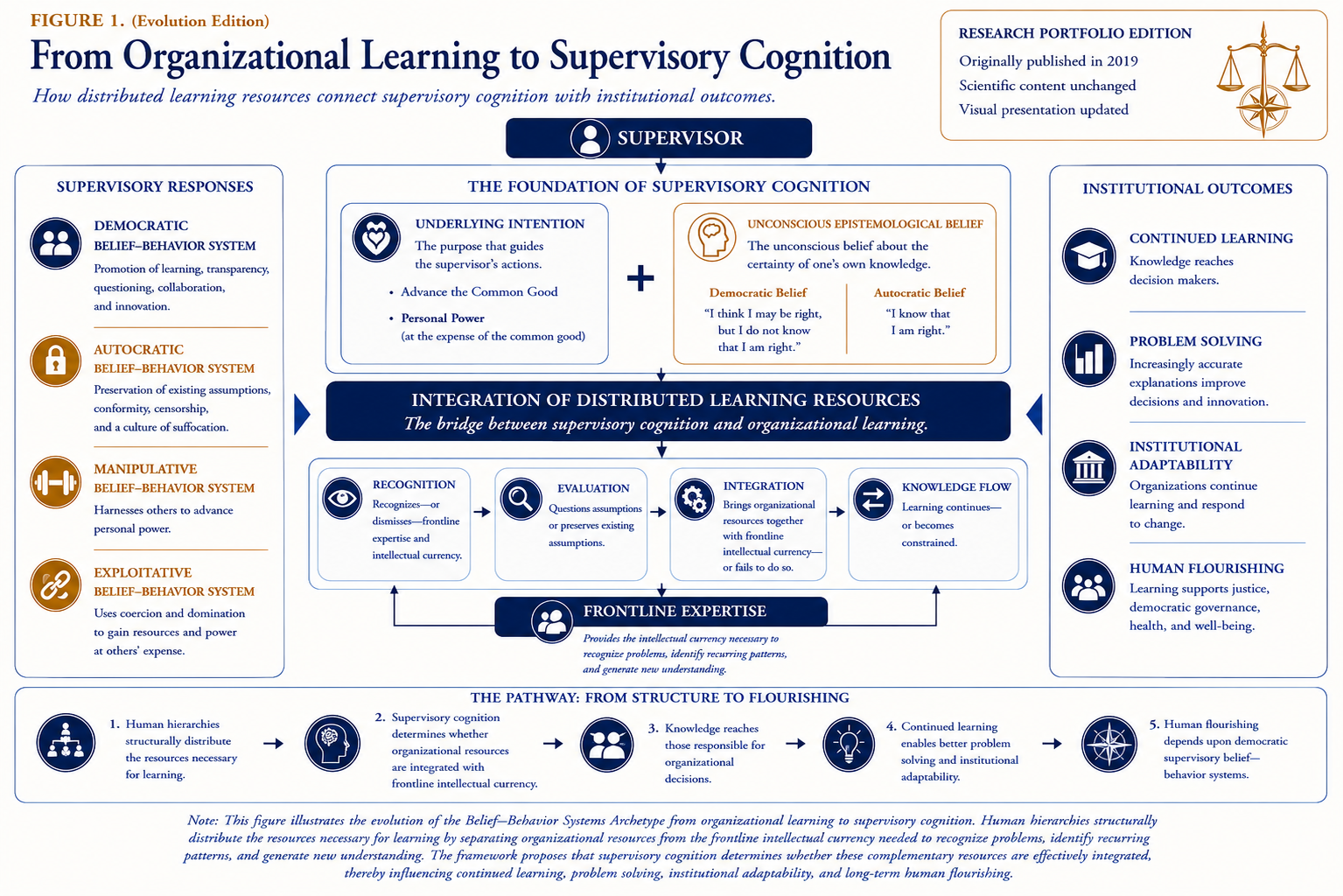
The research began by investigating a fundamental difference between individual human learning and learning within human hierarchies. Whereas individuals generally control the resources necessary for their own learning, human hierarchies structurally distribute those resources across supervisory relationships. Organizational resources such as authority, responsibility, funding, time, and decision-making capacity often reside with supervisors, while those closest to the work possess the frontline expertise and intellectual currency necessary to recognize problems, identify recurring patterns, discover previously unrecognized limitations in current understanding, and generate new explanations.
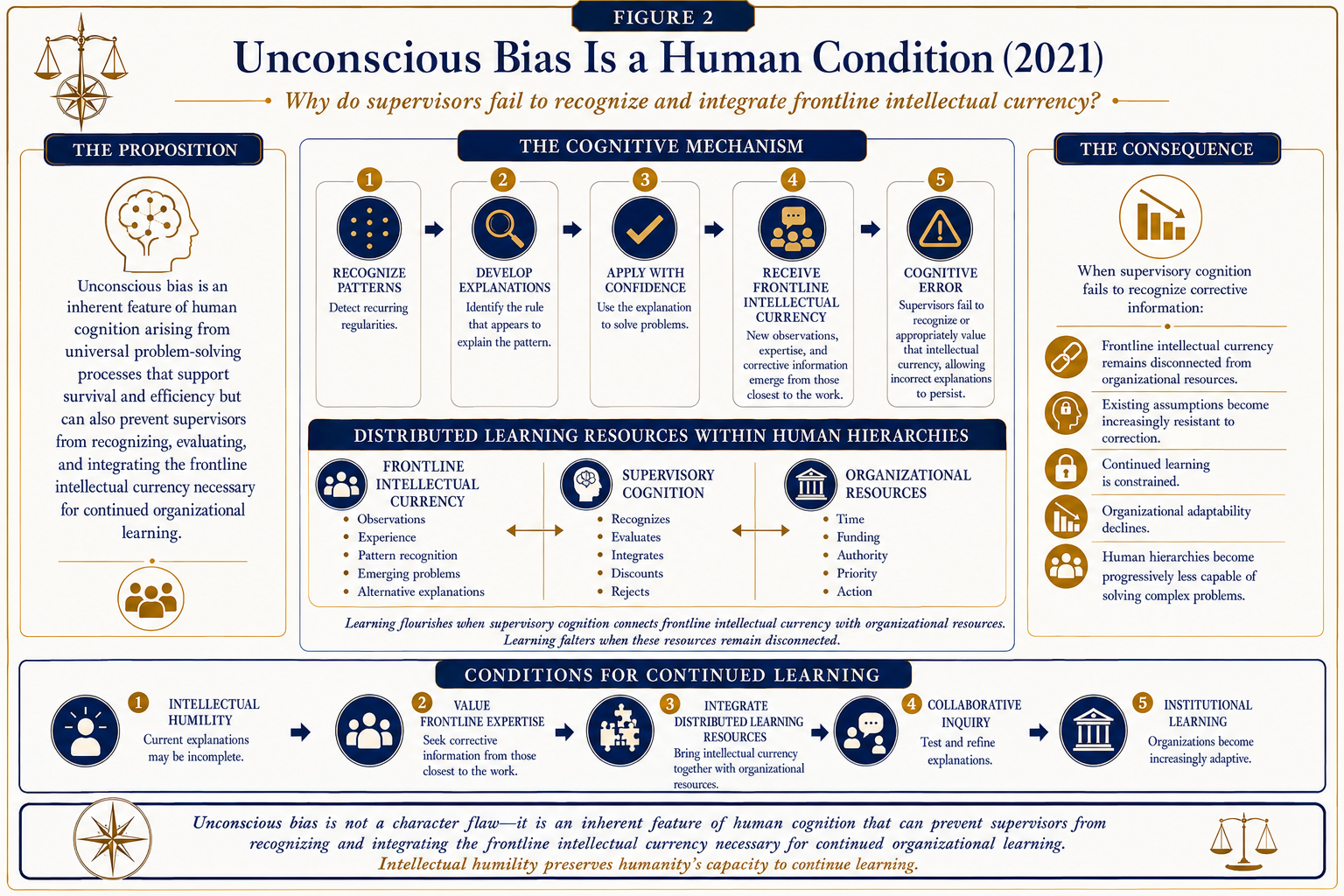
This structural distribution gives human hierarchies extraordinary capacity for specialization, coordinated effort, innovation, and collective problem solving. At the same time, however, it creates a fundamental structural and cognitive vulnerability. A hierarchy may possess the knowledge necessary to recognize or solve a problem without that knowledge becoming available to those responsible for allocating the organizational resources necessary to investigate or act upon it. Supervisors can therefore become insulated from the very intellectual currency necessary to recognize and correct limitations in their own understanding.
The research consequently progressed from investigating the structural organization of learning within human hierarchies, to examining how unconscious cognitive error can become incubated and protected by that structure, to investigating how supervisory belief–behavior systems influence subordinate adaptation and organizational knowledge flow, and ultimately to identifying a proposed cognitive and epistemological mechanism underlying these recurring supervisory patterns.
Together, these investigations connected two complementary levels of explanation. The first concerns the structural distribution of intellectual and organizational resources within human hierarchies. The second concerns the cognitive and epistemological processes that determine whether those distributed resources become available for continued learning and collective problem solving.
Importantly, the research also suggested that although the epistemological beliefs underlying supervisory cognition may operate largely outside conscious awareness, their observable expressions provide opportunities for investigation. Supervisors' feelings and thoughts when engaging with frontline intellectual currency, whether they inherently value and utilize that intellectual currency to facilitate continued learning, how they use organizational tools and resources, and the adaptive behaviors that emerge among those they supervise may all function as feedback about the underlying supervisory belief–behavior system. These observable patterns create opportunities not only to explain supervisory cognition, but also to recognize previously unrecognized cognitive error and intentionally preserve or restore the conditions necessary for continued learning.
The sections below trace this scientific progression through three peer-reviewed publications and the subsequent development of the Belief–Behavior Systems Archetype as a proposed explanatory, diagnostic, and developmental framework for investigating how supervisory cognition influences whether the distributed resources necessary for learning are recognized, valued, and effectively integrated within human hierarchies. As the framework developed, this question broadened beyond how hierarchies preserve learning and adaptability to include how the supervisory environments created through these processes may affect the participation, well-being, and flourishing of the people whose intellectual currency makes continued learning possible.
From Scientific Questions to a Continuing Research Program
Taken together, these investigations reveal a continuous scientific progression concerning both the extraordinary adaptive capacity of human hierarchies and the fundamental structural and cognitive vulnerability created by their organization.
The first investigation identified the structural problem. Human hierarchies differ fundamentally from individual learners because the resources necessary for learning become distributed across supervisory relationships. This distribution dramatically expands humanity's capacity for specialization, coordinated effort, innovation, and collective problem solving. At the same time, however, it creates a dependency: continued learning within human hierarchies requires the intellectual resources distributed throughout the hierarchy to become effectively integrated with the organizational resources necessary to investigate problems and act upon new understanding.
The second investigation identified a cognitive vulnerability created by that structure. Unconscious cognitive error is an inherent feature of human cognition: people naturally recognize recurring patterns, develop explanatory rules, and apply those explanations to solve problems while sometimes failing to recognize evidence that their existing understanding is incomplete or incorrect. Within human hierarchies, however, the observations, expertise, and corrective intellectual currency capable of revealing supervisory cognitive error may reside elsewhere in the hierarchy.
The structural distribution of learning resources can therefore insulate unconscious supervisory cognitive error from correction. A hierarchy may possess the knowledge necessary to reveal a problem or limitation in supervisory understanding without that knowledge becoming available to—or appropriately valued by—the supervisor whose understanding requires correction.
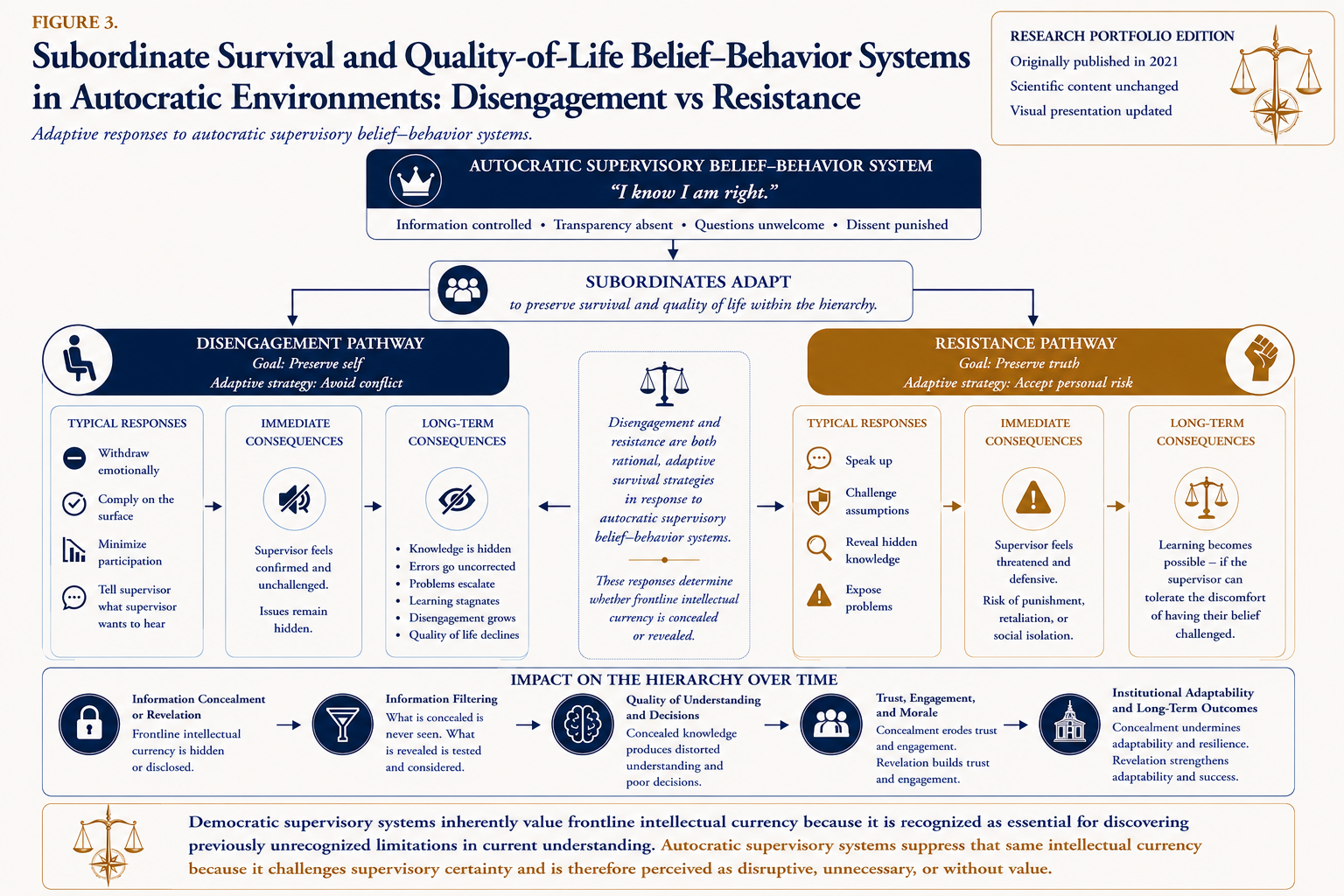
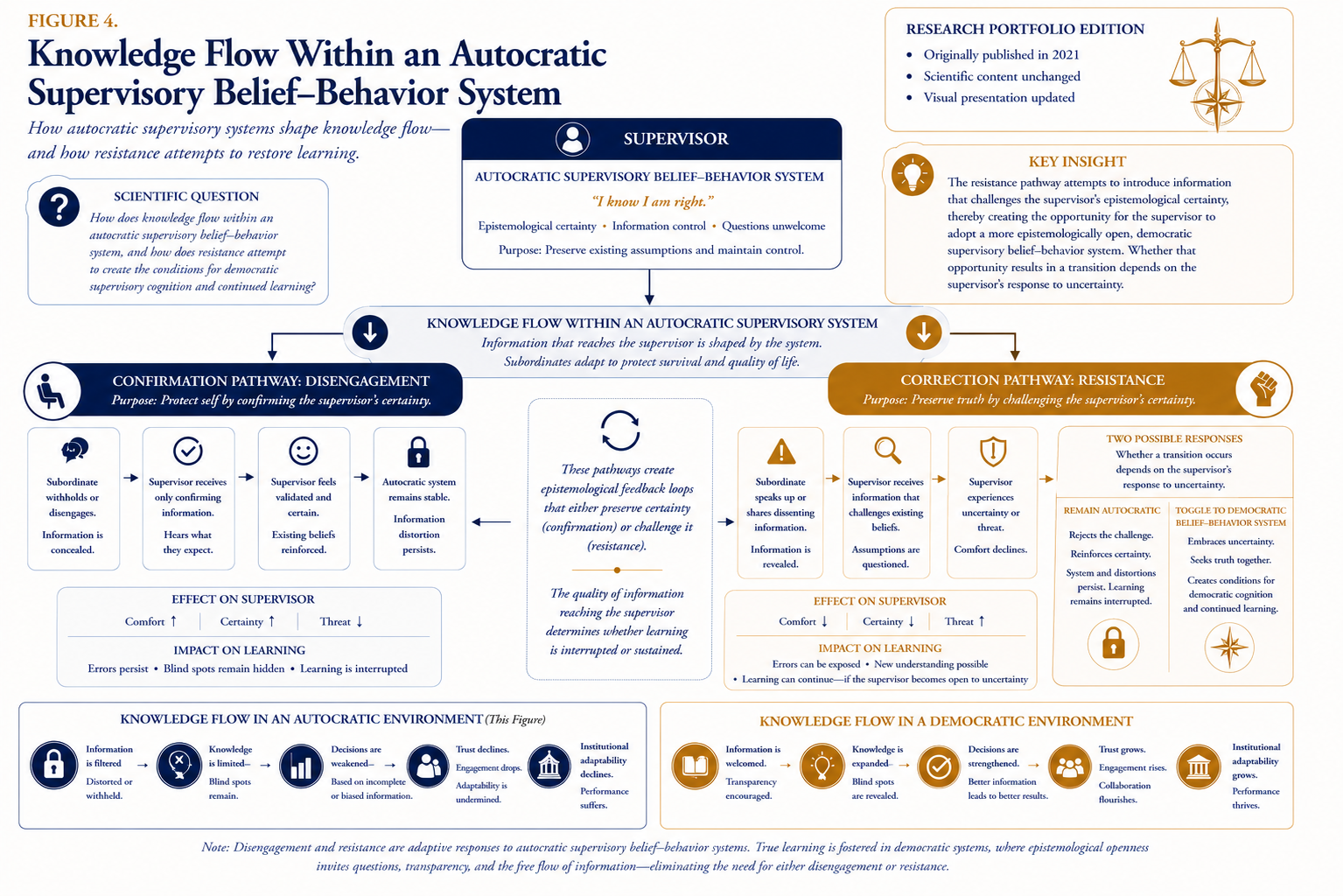
The third investigation examined how this vulnerability becomes expressed through supervisory relationships and knowledge flow. Supervisory belief–behavior systems influence whether frontline intellectual currency is sought, valued, evaluated, integrated, ignored, discouraged, or suppressed. Subordinates simultaneously adapt to the prevailing supervisory environment through recurring patterns that may include engagement, truth-seeking disclosure, conformity, disengagement, resistance, and concealment of what they know.
Knowledge flow therefore emerges through an interaction between how supervisors respond to distributed intellectual currency and how those responses influence whether subordinates continue making that intellectual currency available. Supervisory and subordinate belief–behavior systems together influence whether knowledge distributed throughout the hierarchy becomes available for continued learning or remains concealed, filtered, or disconnected from consequential action.
These investigations ultimately led to a deeper question: What underlying cognitive and epistemological mechanism gives rise to these recurring supervisory belief–behavior systems?
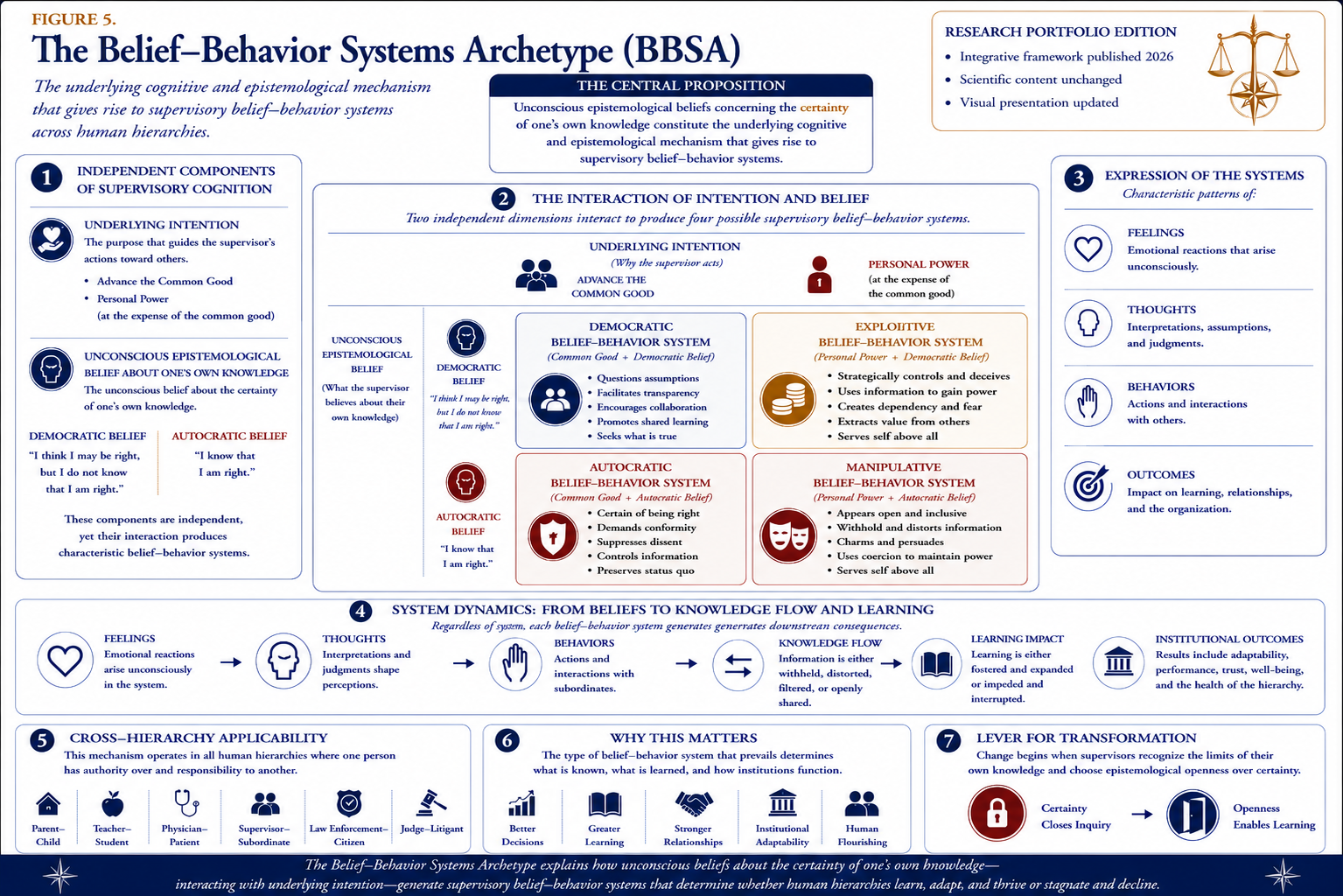
The Belief–Behavior Systems Archetype proposes that supervisory cognition emerges through the interaction of two independent components: underlying supervisory intention and unconscious epistemological belief concerning the completeness of one's own knowledge.
The two components perform different functions within the proposed architecture. Supervisory intention concerns the end toward which authority is directed—advancing the common good or advancing personal power at the expense of the common good. Unconscious epistemological belief concerns the supervisor's relationship to the limitations of current understanding—whether the supervisor remains open to the possibility that their knowledge is incomplete or closed to that possibility.
Their interaction is proposed to give rise to recurring democratic, autocratic, manipulative, and exploitative supervisory belief–behavior systems across diverse human hierarchies.
This proposed mechanism closes the explanatory loop opened by the first investigation.
The research began with the discovery that human hierarchies structurally distribute the resources necessary for learning. The mature framework returns to that structural problem and proposes supervisory cognition as the integrative mechanism influencing whether those distributed resources are successfully brought back together.
The scientific progression can therefore be expressed as:
Structural Distribution of Learning Resources
↓
Hierarchical Insulation of Cognitive Error
↓
Supervisory and Subordinate Adaptation and Knowledge Flow
↓
Underlying Supervisory Cognition
↓
Integration or Separation of Distributed Learning Resources
The framework consequently proposes that supervisory cognition influences whether the very structure that gives human hierarchies their extraordinary capacity for collective learning facilitates continued learning or protects existing cognitive error from correction.
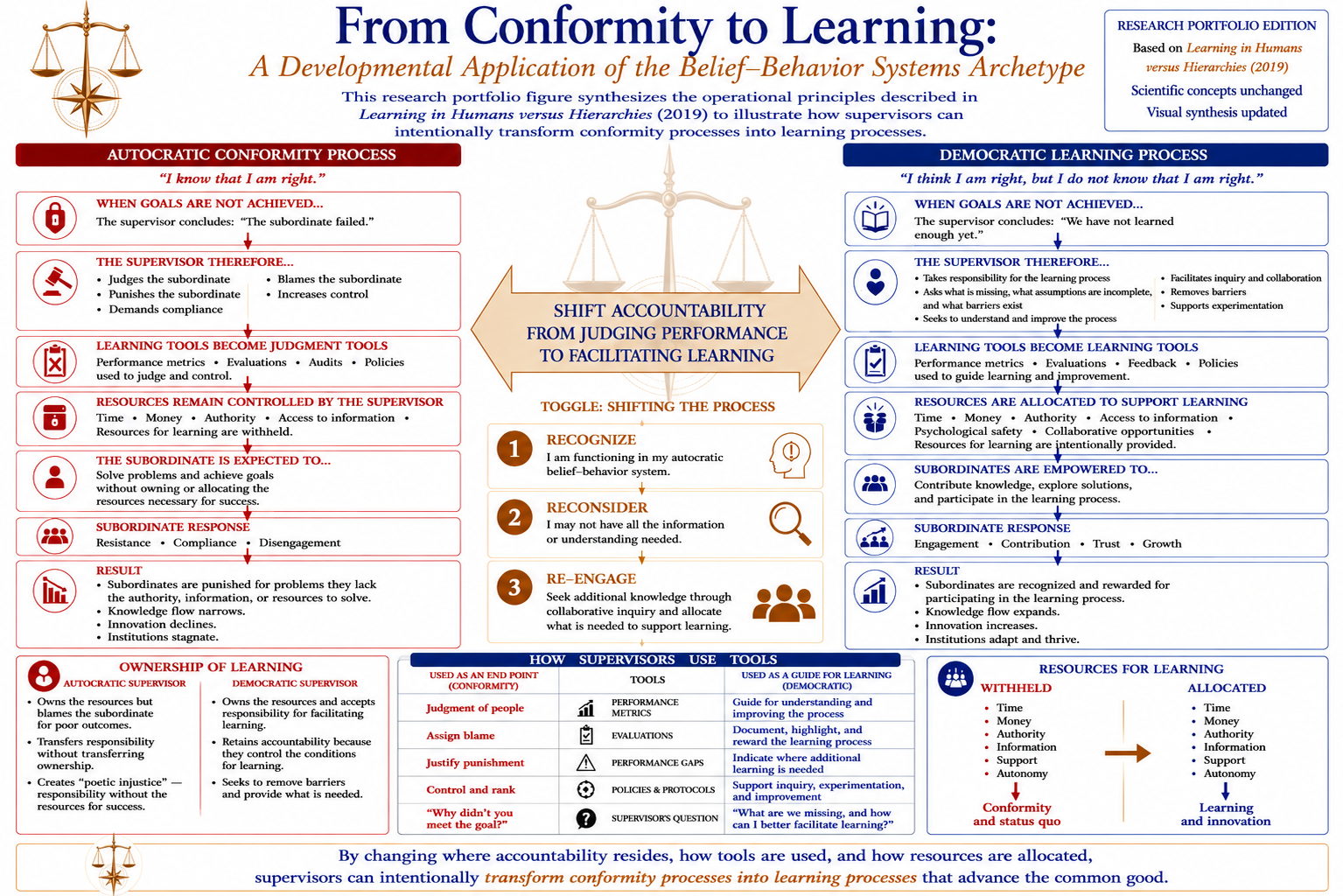
When supervisors remain open to the possibility that their knowledge is incomplete, frontline intellectual currency can become inherently valuable because it may reveal previously unrecognized limitations in current understanding. Questions, disagreement, alternative explanations, and corrective information can therefore be sought and integrated with the resources necessary to investigate problems and develop new understanding.
When supervisors are closed to the possibility that their knowledge is incomplete, that same intellectual currency may instead be experienced as disruptive, unnecessary, or without value. Corrective knowledge may then be ignored, discouraged, censored, or suppressed, leaving organizational resources disconnected from the information necessary to recognize and correct existing cognitive error.
The framework therefore connects two complementary levels of explanation:
Structural: human hierarchies distribute the resources necessary for learning.
Cognitive and epistemological: supervisory cognition influences whether those distributed resources are subsequently reintegrated for continued learning.
This relationship transforms the original structural observation into a proposed explanatory architecture for learning within human hierarchies:
Human hierarchies expand humanity's capacity for collective learning by distributing the resources necessary for learning. Supervisory cognition influences whether those distributed resources are brought back together.
The mature framework also reveals a broader implication. The same supervisory environments that influence whether intellectual currency remains available for collective learning may influence the experience and adaptation of the people who hold that intellectual currency. Democratic belief–behavior systems may preserve not only questioning, corrective information, and knowledge integration, but also meaningful participation in collective problem solving. Conversely, environments in which intellectual currency is repeatedly ignored, discouraged, censored, or suppressed may contribute to withdrawal, conformity, disengagement, and other forms of subordinate adaptation.
The continuing research program therefore extends beyond the question of whether human hierarchies can learn and adapt. It also raises the question of whether they can sustain the participation and well-being of the people whose knowledge and effort make that learning and adaptation possible. In this sense, institutional adaptability and human sustainability may represent interconnected dimensions of sustainable human hierarchies.
From Explanation to Diagnosis and Development
The research progression also suggests that the underlying mechanism may be open to investigation and intentional development.
Although unconscious epistemological beliefs are proposed to operate largely outside conscious awareness, they may produce recurring observable patterns. Supervisors can therefore examine their feelings and thoughts when engaging with frontline intellectual currency; whether they inherently seek, value, and utilize that intellectual currency to facilitate continued learning; how they use authority, accountability, organizational tools, and resources; and the adaptive behaviors that emerge among those they supervise.
These patterns are not proposed as isolated diagnostic tests. Rather, taken together, they may provide feedback about the supervisory belief–behavior system currently operating and create opportunities to recognize previously unrecognized cognitive error.
The framework therefore extends beyond explaining why supervisory systems emerge. It proposes a pathway through which supervisors may become better able to recognize the unconscious epistemological beliefs influencing their relationships with knowledge, uncertainty, and the intellectual currency of others—and intentionally strengthen the conditions necessary for continued learning.
The continuing research program now asks whether these propositions can be measured, tested, challenged, refined, and intentionally applied across diverse human hierarchies.